

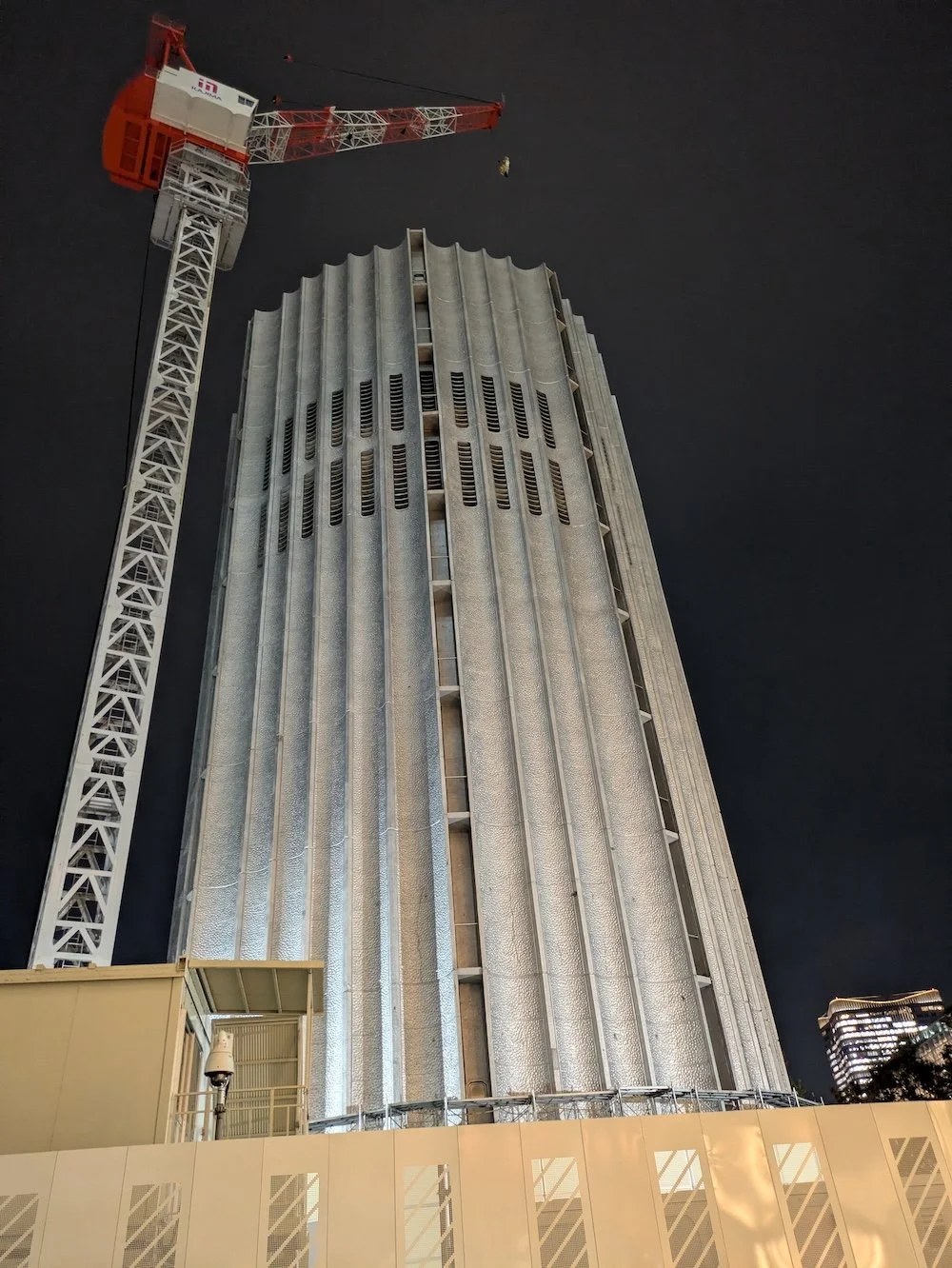
Tokyo landmarks: The Dark Tower of Otemachi has a crane now
This is a follow-up to an article I wrote on July 10th about the strange concrete building in Otemachi that I had walked past for years without ever understanding what it was.
In my head I called it the Dark Tower. It sits among all the polished glass towers looking slightly menacing and completely uninterested in fitting in. Eventually I discovered that it was basically a telecom hub, which explained the lack of windows, the heavy concrete and the general appearance of a building designed to survive something.
I thought that was the end of the story.
But last week I walked past it again and noticed there is now a crane next to it.
Read more by clicking on the link.

Tokyo landmarks: From the Empire State Building to Tokyo Skytree
A recent trip to New York gave me the chance to finally visit the iconic Empire State Building.
Standing on the observation deck, looking out over Manhattan, I couldn't help but compare the experience to one of my favorite Tokyo landmarks: Tokyo Skytree.
Of course, the two towers are very different. The Empire State Building feels like a living piece of history. It has that unmistakable Art Deco elegance and reminds visitors of a New York from another era. Tokyo Skytree, on the other hand, represents modern Japan. Sleek, futuristic, and purpose-built, it feels very much like a symbol of today's Tokyo.
Read more by clicking on the link.

Beating the heat in Japan, literally
Whenever people talk about summer in Japan, the first thing they mention is usually the heat. And fair enough. Japanese summers are not subtle. The air feels thick, shirts stick to your back within seconds, and even the cicadas seem to be screaming about the temperature.
But what I always loved was how communities seemed to have developed hundreds of little ways to make summer not just bearable, but enjoyable.
When I lived in Yamanouchi, a neighborhood in Kita-Kamakura tucked between temples, forests, and narrow winding roads, one of my favorite signs that summer had truly arrived was hearing drums in the distance. Eventually, a tiny truck would emerge from somewhere in the greenery, carrying musicians and festival lanterns, somehow navigating roads that looked barely wide enough for the truck itself.
To this day, I have no idea how they managed some of those corners.
Read more by clicking on the link.

Tokyo landmarks: The “Giant Golden Poop” in Asakusa
I love that this is one of those classic Japan moments where something is supposed to be very profound and artistic, but an entire nation has quietly agreed on a completely different interpretation.
Walking through Asakusa, it is impossible to miss the giant golden object perched on top of the black building across the Sumida River. Officially, it is called the "Flamme d'Or" or Golden Flame, and it was designed by French designer Philippe Starck as part of the Asahi Beer headquarters complex. The flame is meant to represent the burning heart of Asahi's brewing spirit.
Which is a lovely idea.
Unfortunately, to many people, including me, it looks much less like a blazing flame and much more like something a very large golden dog may have left behind.
Read more by clicking on the link.

Tokyo landmarks: The Dark Tower of Otemachi
For years I walked past this building and never once understood it.
It sits there in Otemachi surrounded by glass towers trying very hard to look modern, and then there’s this thing. Solid, ribbed concrete, barely any windows, just kind of looming like it knows something the rest of us don’t. I always thought it looked completely out of place, like it had been dropped in from a different version of Tokyo.
In my head I called it the Dark Tower. It felt like the kind of place where something important was happening, but no one was supposed to ask questions. Not a normal office, not a hotel, definitely not somewhere you casually walk into.
Read more by clicking on the link.

Tokyo landmarks: The Ginza 1-chome Koban
Every time I see a koban like this, I do a double take. A koban is basically a small neighborhood police box, usually simple, practical, and easy to spot when you need help. You’ll find them all over Japan, and they’re the place you go for directions, lost items, or just general “I’m a bit stuck” moments.
And then there are koban like this one in Ginza 1‑chome. Brick base, round window, and that curved, almost cone-shaped top that looks more like it belongs in a design museum than on a street corner. It’s been a bit of a local landmark for years, with its current look dating back to the Showa era when there was a push to give even small public buildings a bit more architectural personality. It has been updated over time, but it has kept that distinctive shape that makes people notice it.
Read more by clicking on the link.

Off the beaten path: Atami in Shizuoka
There is a very specific kind of luxury in Japan that starts with almost no planning at all.
You just get on a train.
Atami was always that place for me. Close enough to Tokyo that it barely feels like a trip, but just far enough for something to shift. In under an hour, the city drops away, the air turns softer with the sea nearby, and a weekend suddenly feels within reach.
I used to go there more often than I had any real reason to. Not for sightseeing, not for a checklist, but for onsen.
There is something about hot spring water that resets you faster than anything else. You arrive carrying a bit of Tokyo with you, and within minutes, that background noise fades.
What I always liked about Atami is how easily that starts. Even at the station.
Read more by clicking on the link.

Off the beaten path in Tokyo: the Statue of Liberty in Odaiba
Japan has a wonderful habit of surprising you with things you absolutely did not expect to find, like walking around Tokyo and suddenly spotting the Statue of Liberty greeting you from across the water. One minute you’re in Odaiba, admiring Rainbow Bridge and the futuristic skyline, and the next you’re lining up a photo that looks suspiciously like New York… except it’s definitely not.
What makes this moment even more special for me is the timing. I took this picture about a month before I moved to the US in 2018. At the time, I had no idea what life in America would look like or how much of Japan I’d end up missing. Fast forward to now: I live in the Bay Area, surrounded by plenty of iconic American scenery, and yet, true to form, I still haven’t made it to New York. My first, and so far only, encounter with Lady Liberty remains firmly rooted in Tokyo. Somehow that feels perfectly on‑brand for my cross‑cultural life.
Read more by clicking on the link.