

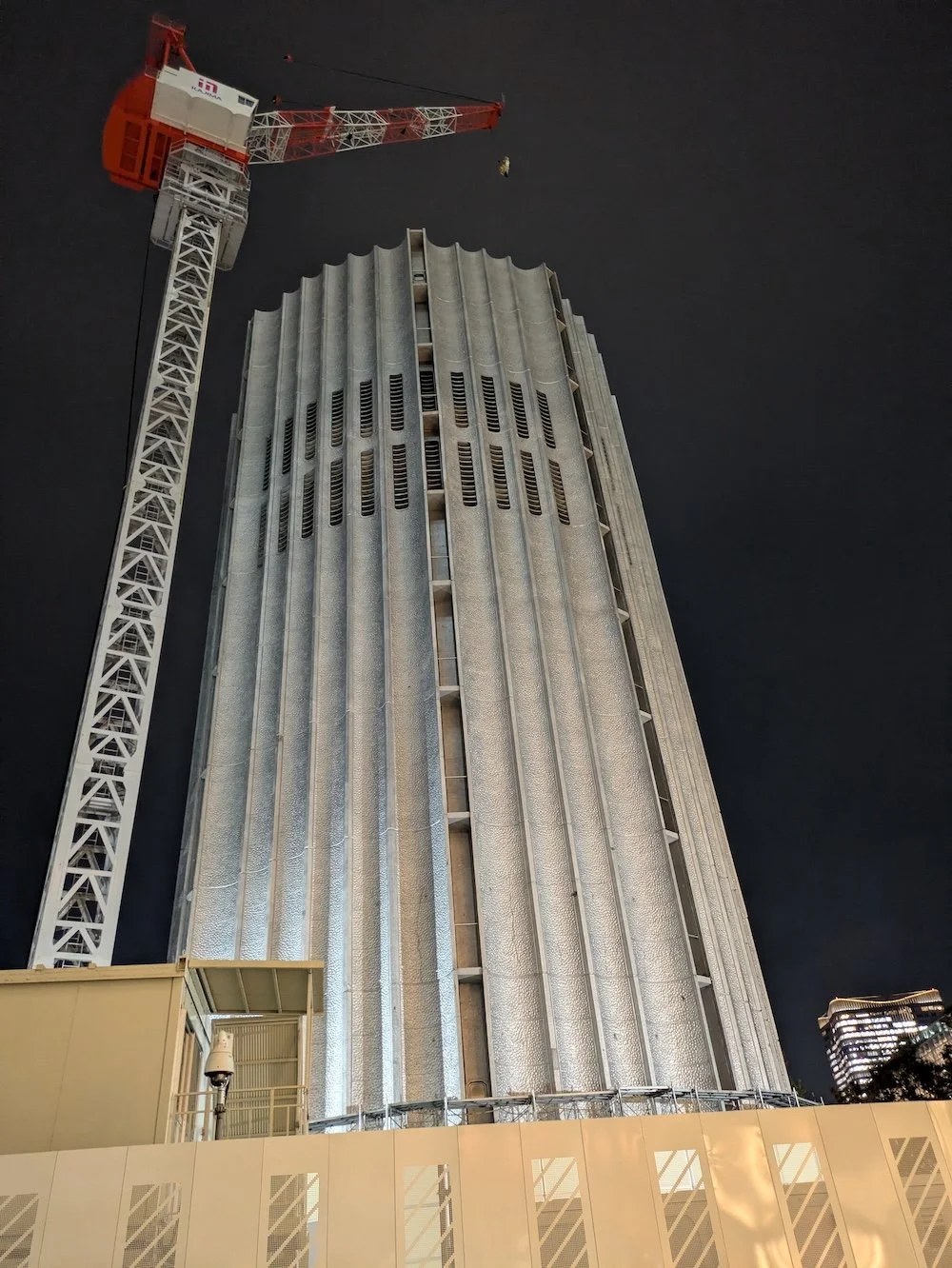
Tokyo landmarks: The Dark Tower of Otemachi has a crane now
This is a follow-up to an article I wrote on July 10th about the strange concrete building in Otemachi that I had walked past for years without ever understanding what it was.
In my head I called it the Dark Tower. It sits among all the polished glass towers looking slightly menacing and completely uninterested in fitting in. Eventually I discovered that it was basically a telecom hub, which explained the lack of windows, the heavy concrete and the general appearance of a building designed to survive something.
I thought that was the end of the story.
But last week I walked past it again and noticed there is now a crane next to it.
Read more by clicking on the link.

Forget the souvenirs, take me to the supermarket
By the time you're reading this, I'll be in Japan.
As I write this, though, I'm still sitting in California and already thinking about what might be the highlight of my shopping adventures: the local supermarket near my friend's house.
I know. Not exactly the glamorous Japan shopping story people expect.
Most travelers dream about department stores, luxury brands, or filling a suitcase with souvenirs. Meanwhile, I'm looking forward to standing in front of a shelf of noodles for twenty minutes trying to decide which varieties absolutely must come home with me.
Read more by clicking on the link.

A Pumpkin Soupuccino, anyone?
A few years ago, if someone had told me that one day I'd walk into Starbucks and order a pumpkin soup, I would have assumed they were joking.
Yet here we are.
I recently came across an article on SoraNews24 about Starbucks Japan's new Pumpkin Soupuccino, and it immediately caught my attention. Not because I'd tried it, but because I'd never even had the chance. The drink is a recent addition, and since I left Japan in 2018, this is one seasonal Starbucks creation that completely escaped me.
Still, it feels perfectly Japanese.
Read more by clicking on the link.

Tokyo landmarks: From the Empire State Building to Tokyo Skytree
A recent trip to New York gave me the chance to finally visit the iconic Empire State Building.
Standing on the observation deck, looking out over Manhattan, I couldn't help but compare the experience to one of my favorite Tokyo landmarks: Tokyo Skytree.
Of course, the two towers are very different. The Empire State Building feels like a living piece of history. It has that unmistakable Art Deco elegance and reminds visitors of a New York from another era. Tokyo Skytree, on the other hand, represents modern Japan. Sleek, futuristic, and purpose-built, it feels very much like a symbol of today's Tokyo.
Read more by clicking on the link.

Off the beaten path in Ishikawa: Yu no Kuni no Mori
I've been writing a lot recently about my first stay in Komatsu. It was such a wonderful place to experience living in Japan for the first time. As I've been revisiting those memories, more and more stories keep coming back to me.
One place that immediately came to mind was Yū no Kuni no Mori, which translates as "The Forest of the Hot Spring Country."
I first visited in 1997, during my early years in Japan, and what I expected to be an interesting day trip turned into something much more memorable. Looking back, it was one of the places that deepened my appreciation for Japanese artisanship and aesthetics.
Read more by clicking on the link.

Off the beaten path in Ishikawa: Natadera Temple in Komatsu
A few weeks ago I shared some memories of visiting the Hanibe caves when I was living in Komatsu. Around the same time, I also spent a lot of time exploring another of the area's best-known attractions, Natadera Temple.
The two places could not be more different. Hanibe is quirky, unexpected and a little surreal. Natadera, on the other hand, is peaceful, beautiful and one of those places that makes you stop and slow down for a while.
Read more by clicking on the link.

The Great Escalator Divide
After years in Japan, I've stopped noticing it, but visitors always do:
In Tokyo, people generally stand on the left and walk on the right.
In Osaka, people generally stand on the right and walk on the left.
Now why would that be!
Read more by clicking on the link.

The flip flop: If the headline is right, Japan designed it and America sold it
I came across a headline recently suggesting that the modern flip flop has roots in both Japan and the US, and honestly, that sounded just random enough to make me curious.
As it turns out, the traditional Japanese zōri sandal has been around for centuries. Then, after the war, versions of it started gaining popularity overseas. Somewhere along the way, Japanese design met American production and marketing, and before anyone knew it, the flip flop had conquered beaches, swimming pools, backyards, and airport security lines around the world.
Read more by clicking on the link.