

From Tokyo sidewalk gardens to my balcony
Walking through residential streets in Tokyo, especially around Kiyosumi Shirakawa, I remember how the city would occasionally soften without warning. One moment it was concrete and utility poles, the next it was a quiet row of pots edging into the street, as if someone had gently expanded their home by a few inches.
In those neighborhoods, the sidewalk often carried these small, personal gardens. Plants arranged in front of houses in mismatched containers, some elevated, others directly on the ground. Nothing symmetrical, nothing styled in a deliberate way, and yet it always felt intentional. A bicycle leaning nearby, a hose tucked away, a doorway half visible behind the leaves. Everyday life continuing right alongside this thin band of green.
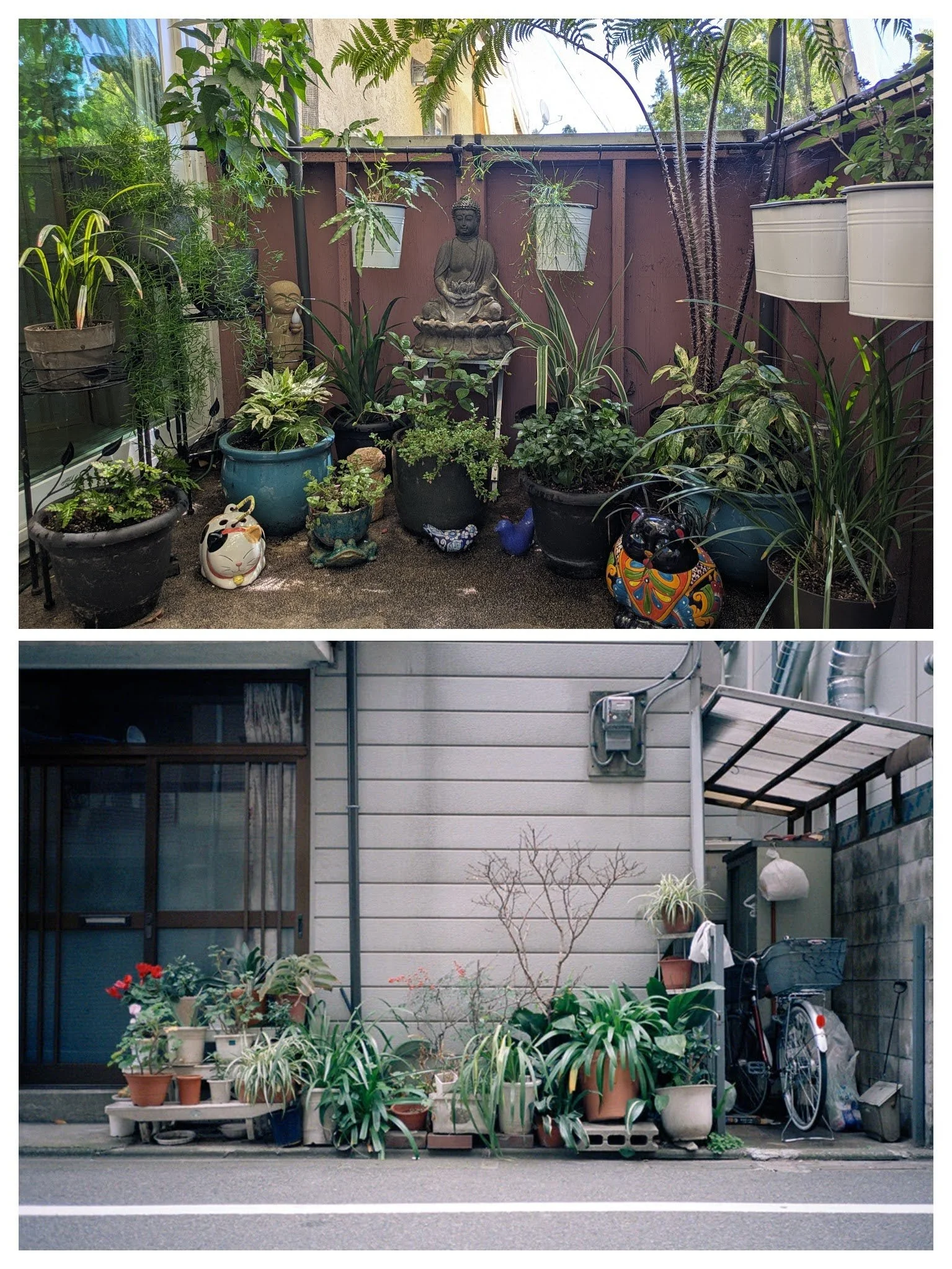
Living in Kiyosumi Shirakawa, I started to notice how consistent this was. Each home had its own variation, its own rhythm. Some were dense and almost overflowing, others sparse and carefully spaced. You could sense the person behind them without ever meeting them. It felt less like decoration and more like a quiet habit, repeated day after day.
It makes sense in the context of Tokyo. Space has always been limited, and traditional private gardens are not something most people can maintain in the city. At the same time, the relationship with plants and seasons runs deep. Bringing greenery into daily life happens at a smaller scale, in ways that fit the constraints rather than resisting them. The narrow strip between house and street becomes just enough.
There is also something understatedly communal about it. Even though the plants belong to someone, they are experienced by everyone passing by. They soften the street, mark subtle seasonal shifts, and add a sense of care to places that might otherwise feel purely functional. No one announces it, but collectively the street becomes greener.
That stayed with me more than I expected. When I later had only a small balcony, it was those streets that came back to mind. Not in a clear plan, but as a feeling I wanted to recreate. I did not try to make a perfect balcony garden. If anything, I leaned into the slightly improvised look I had seen so many times.
A few pots turned into more. Containers did not match, and I stopped trying to make them. Some plants grew well, others struggled, and the arrangement kept shifting depending on where the light landed and what seemed to be working that week. It never looked polished, but it started to feel alive in the same way those Tokyo sidewalks did.
The more enclosed, lush style you sometimes see, where plants cluster tightly and create a kind of small sanctuary, feels like a natural extension of the same idea. When the space allows it, the garden turns inward and becomes immersive instead of something you pass by. Different setting, same instinct.
What changed for me was less about how it looked and more about how it felt to use the space. Stepping onto the balcony became a small pause in the day. Noticing new growth, moving a pot a few inches, reacting to the weather in a slightly more observant way. Small actions, easy to overlook, but they shift your attention.
Looking back, what I took from Kiyosumi Shirakawa was not a style so much as an approach. The plants were part of daily life, not a finished project. Always in progress, slightly uneven, shaped by routine more than design.
Even now, whenever I add another plant or rearrange what is already there, I think about those quiet residential streets. How a simple row of pots could make a narrow space feel more generous. How something so small could change the atmosphere of an entire block.
It is easy to miss if you are not looking for it. But once you notice it, it becomes hard to forget.
Tokyo garden photo copyright: https://thegardenedit.com/blogs/journal/14501213-tokyo-potted-gardens
