

Inside Chiharu Shiota’s world at the Asian Art Museum
The recent opening night of Chiharu Shiota’s exhibition at the San Francisco Asian Art Museum was one of those experiences that stays with you long after you leave the building.
I went with a friend who worked at the museum for many years, which gave the evening an added layer of meaning. Walking through the galleries with someone who knows the institution from the inside, who understands the care and intention behind each exhibition, made the night feel both personal and quietly celebratory. It wasn’t just an opening. It was a shared moment with art, memory, and place.
Shiota’s work is often described as immersive, but that word barely captures the emotional weight of what unfolds once you step inside her installations. Thread, space, absence, and presence all intertwine. You don’t simply view the art; you move through it, and in doing so, become part of it.
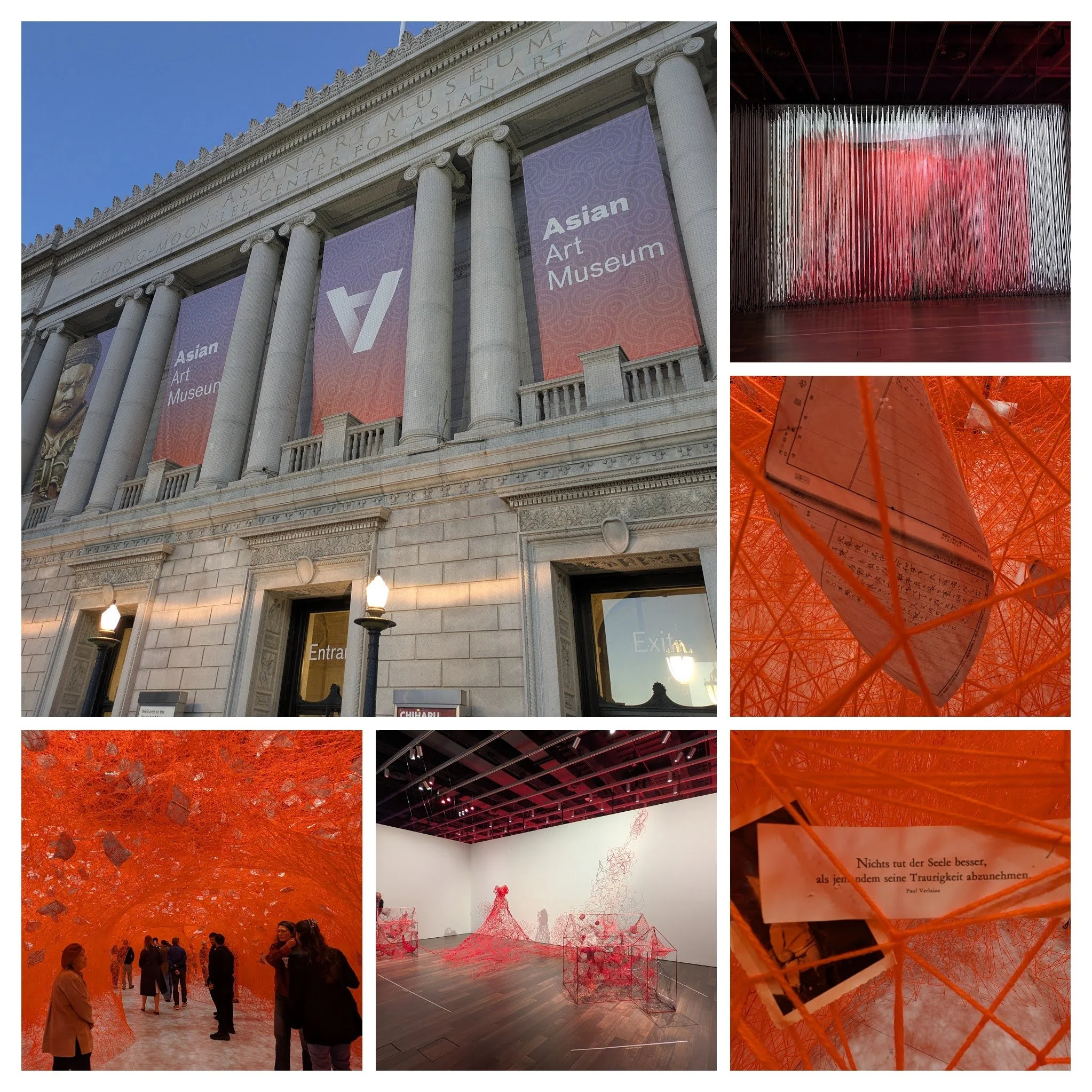
The piece that impacted me most was a structure made of red yarn stretched like a large spider‑web tunnel. Stepping into it felt almost ceremonial. The yarn envelops you, creating a dense yet delicate passageway that seems to hold countless invisible stories. Suspended within the web are messages written in German and Japanese, languages deeply tied to Shiota’s life and identity. Even without reading every word, their presence is powerful, evoking ideas of memory, displacement, belonging, and the threads that bind us across time and geography.
Red carries layered meaning in Japanese culture. It is associated with life, blood, emotion, and protection. In Shiota’s work, it becomes a way to make the intangible visible. The yarn feels like thought given form, or memory made spatial. Walking through that tunnel, I felt both held and unsettled, which seemed entirely intentional.
Throughout the exhibition, what stood out was how deeply Japanese sensibilities are embedded in Shiota’s work, while still speaking universally. Themes of impermanence, connection, loss, and identity echo strongly. There is a quiet awareness of transience, a sense that meaning exists precisely because nothing is permanent. Her installations do not explain these ideas outright; they allow you to experience them.
Despite the energy of an opening night, the atmosphere remained reflective. People moved slowly. Conversations softened. There was a collective sense of respect for the space and for the emotions the work was stirring. It felt like the kind of exhibition that asks you not to rush, but to linger.
Experiencing this alongside a friend with a long history at the museum made it even more special. It was a reminder that museums are living institutions shaped by the people who care for them over time. Much like Shiota’s threads, those contributions are often unseen, yet they hold everything together.
I left the museum feeling introspective and deeply moved. Shiota’s work does not offer answers. Instead, it creates spaces where memory, emotion, and identity can surface quietly and honestly. It was a powerful evening and a strong reminder of how profoundly contemporary Japanese artists continue to resonate on a global stage.
If you have the opportunity to see this exhibition, give yourself time. Some experiences are meant to be walked through, felt, and carried with you long after you leave.
