

Whispers of Japan in an Oakland landmark
This Monday I am still thinking about my recent visit to the Paramount Theatre in Oakland. I knew it was an Art Deco landmark, but walking up to that towering façade felt almost surreal. The huge mosaic on the front of the building, which you can see in the first image of the collage, is so tall and intricate that it is hard to take in all at once. Standing on the sidewalk, looking up at that vertical mural against the winter sky, I already had the feeling that I was about to step into another era.
Inside, the theatre felt even more dreamlike. The long, soaring lobby and auditorium drew my eyes upward again and again. In the collage, there are a couple of photos taken from the center aisle, looking toward the stage and up into the dramatic green and gold ceiling. Being there in person felt like walking into a golden canyon of light and pattern. Every surface shimmered with details that only reveal themselves slowly, and it is the kind of space where you instinctively lower your voice even when there is no performance happening.
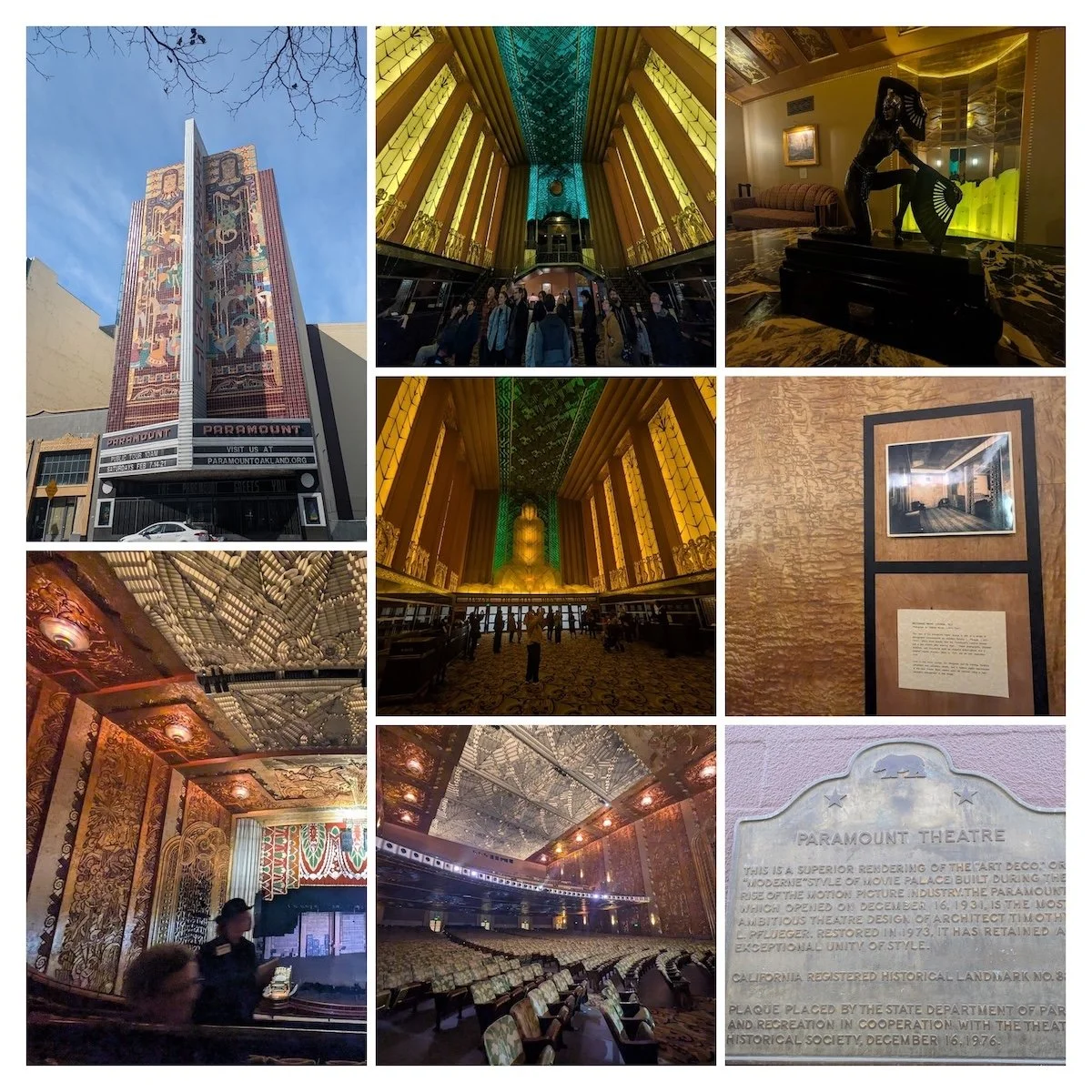
As I wandered around, I kept noticing echoes of Japan in the design. The sculpture captured in the top right of the collage really stopped me. Its stylized lines, the pose, and the rhythm of the shapes felt very much in the spirit of Japonisme, that early twentieth century fascination with Japanese aesthetics. It is not Japanese art in a literal sense, but the flow and serenity of it felt so familiar, like the architects had absorbed elements of Japanese visual language without even meaning to.
The closer I looked, the more these subtle connections appeared. The rich patterned walls and ceilings shown in the lower left and center images reminded me of the way Japanese artisans play with repetition, texture, and shine. It is pure Art Deco, but it also feels like a conversation with the Japanese influences that shaped so much Western design during that period.
And then there was the most unexpected discovery of all: the reference to Hokkaido ash in the upstairs men’s room. In the collage, there is a photo of a framed explanation on the wall with an old image of the space and a note about the materials used. Reading that text about Hokkaido ash in a 1930s theatre restroom in Oakland made me smile. Japan again. Such a small detail, yet a quiet thread tying the building to a place that has become so central in my own life and work.
The last image in the collage, the historic landmark plaque outside, reminded me how carefully this theatre has been preserved. It is not just a beautiful building but a piece of cultural memory. And within that memory, Japan has been present all along, in the wood, the design language, and the global flow of influence that shaped Art Deco itself.
Walking out afterward, I thought about how often Japan appears in my Bay Area life in subtle and unexpected ways. In community gatherings, in stories people share, and now in architecture that has been part of Oakland for nearly a century. Living and working in Japan has changed the way I see the world, and these details stand out instantly now. But this time felt different. It was not me searching for Japan. It was the building revealing that Japan had always been part of its story.
That is the feeling I am carrying into this week: the awareness that cultural connections are often quiet and hidden in plain sight. Sometimes they are tucked into a ceiling pattern, a sculptural curve, or a line on an old plaque. And when we take the time to look closely, like examining a photo collage after the fact, we begin to see how intertwined our worlds have always been.
