

Japonisme, a century-old plate, and the power of memory
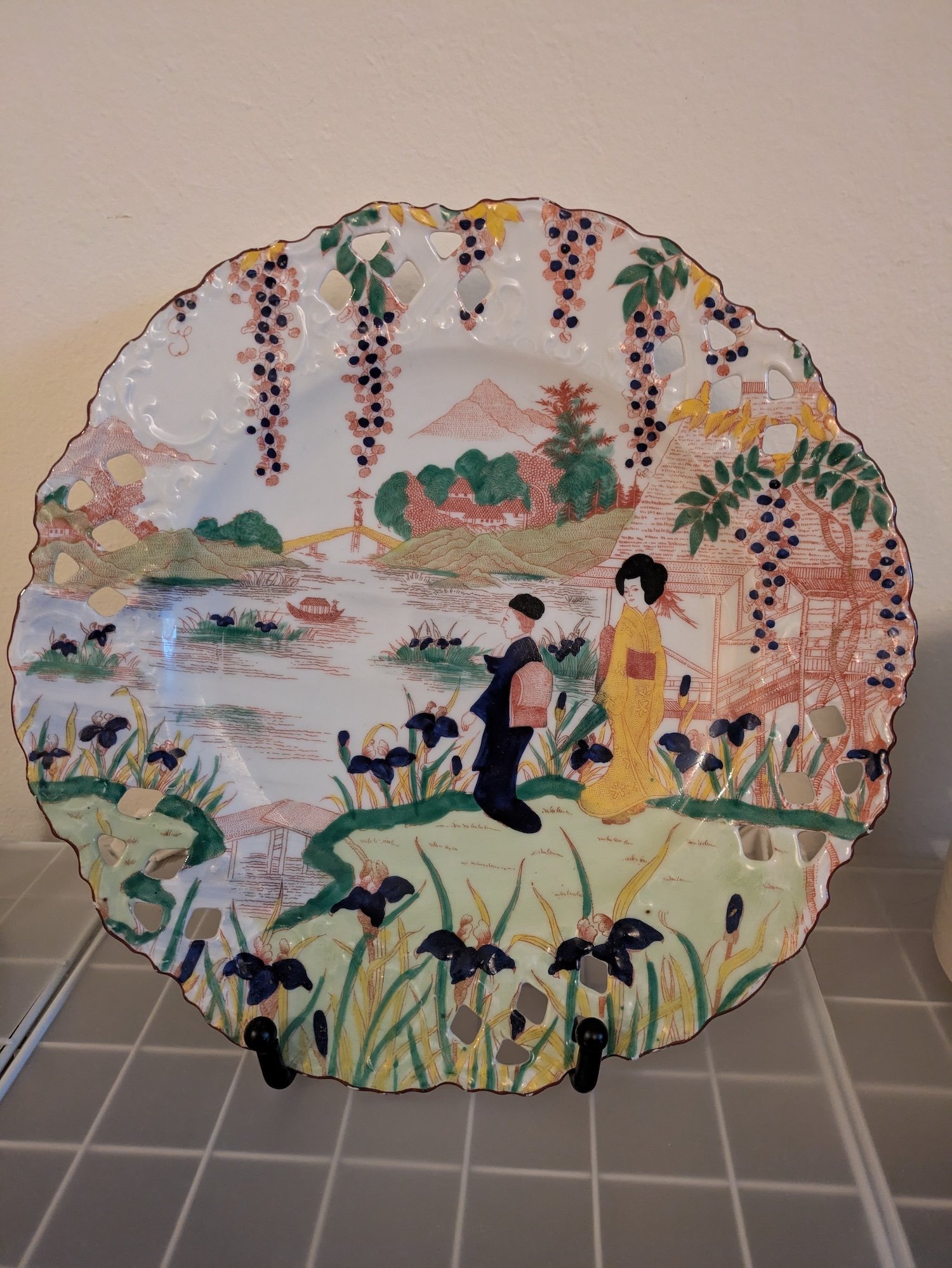
Some objects seem to hold entire worlds within them, quietly waiting for us to notice. This plate has been part of my life for as long as I can remember, yet only recently did I decide to uncover its story. What I found surprised me: it was produced by the Victoria Czecho-Slovakia company sometime between 1890 and 1919, during the height of Art Nouveau.
That discovery felt like a personal connection to an era I’ve always admired, especially growing up in Belgium, where the flowing lines and organic forms of architects like Victor Horta are part of our cultural DNA. The plate’s scalloped edges and intricate design echo that same elegance, but with a twist: a fascination for Japanese aesthetics that swept through Europe at the time. It’s not valuable in money, but its worth to me is immeasurable. And it makes me wonder, why did my great-uncle and aunt choose this piece? Perhaps the answer lies in a movement called Japonisme.
Japonisme: When Europe fell in love with Japan
In the late 19th century, Europe experienced a wave of fascination with Japanese art and design, a movement known as Japonisme. After Japan opened its doors to the West during the Meiji era, Japanese prints, ceramics, and textiles began to flow into European markets. Artists like Monet, Van Gogh, and Whistler were captivated by the simplicity, asymmetry, and natural motifs of Japanese aesthetics. This influence reshaped European art, inspiring everything from Impressionist brushstrokes to Art Nouveau curves.
What made Japonisme so revolutionary was its embrace of imperfection and nature. Where European art often sought symmetry and grandeur, Japanese design celebrated fleeting moments, blossoms in the wind, ripples on water, the quiet grace of everyday life. It was a philosophy as much as an aesthetic, and it resonated deeply with a world in transition.
A plate that holds a world
The plate in front of me is a perfect example of this cultural exchange. Its gen, figures in traditional Japanese attire, a serene river, a bridge in the distance, capture the essence of Japanese artistry as imagined through European eyes. The hanging clusters of grapes, the vivid greens and purples, the idyllic landscape: all speak to a time when Japan was both exotic and enchanting to Western collectors.
This plate doesn’t just represent a cultural exchange, it holds the essence of people I loved dearly. Visiting my great-uncle and aunt was always a special occasion. Their home was a quiet sanctuary, filled with antiques that seemed to whisper stories from another time, while the steady tick of the grandfather clock marked each moment. They always brought out pralines, a small gesture that felt like pure indulgence to a child.
I wish I had visited more often, asked more questions, listened to more stories before they passed away. I’ll never know why they chose this plate or what drew them to its design. But I do know they understood how much I loved it, because they willed it to me. That simple act makes this plate priceless. It’s not just porcelain and paint; it’s a tangible link to two people who shaped my life in quiet, meaningful ways.
And here’s the beautiful part: without realizing it, this plate may have planted the seed that grew into my lifelong fascination with Japan. Its delicate imagery and its quiet elegance perhaps whispered to me in ways I couldn’t name then, inspiring me to learn Japanese years later. Today, when I look at it, I see not only art and history but the beginning of a journey I didn’t know I was on.
