

Tending the past, grounding the present. A day at Colma Japanese Cemetery
Last week, I wrote about human connection and how it often reveals itself in quiet, unplanned moments. This weekend, that idea stayed with me in a different way, as my husband and I spent time volunteering at the Colma Japanese Cemetery with JCCNC and JCCCNC to prepare the grounds for the Memorial Day service.
This was our second year helping with the cleanup, and we already know we will be back next year.
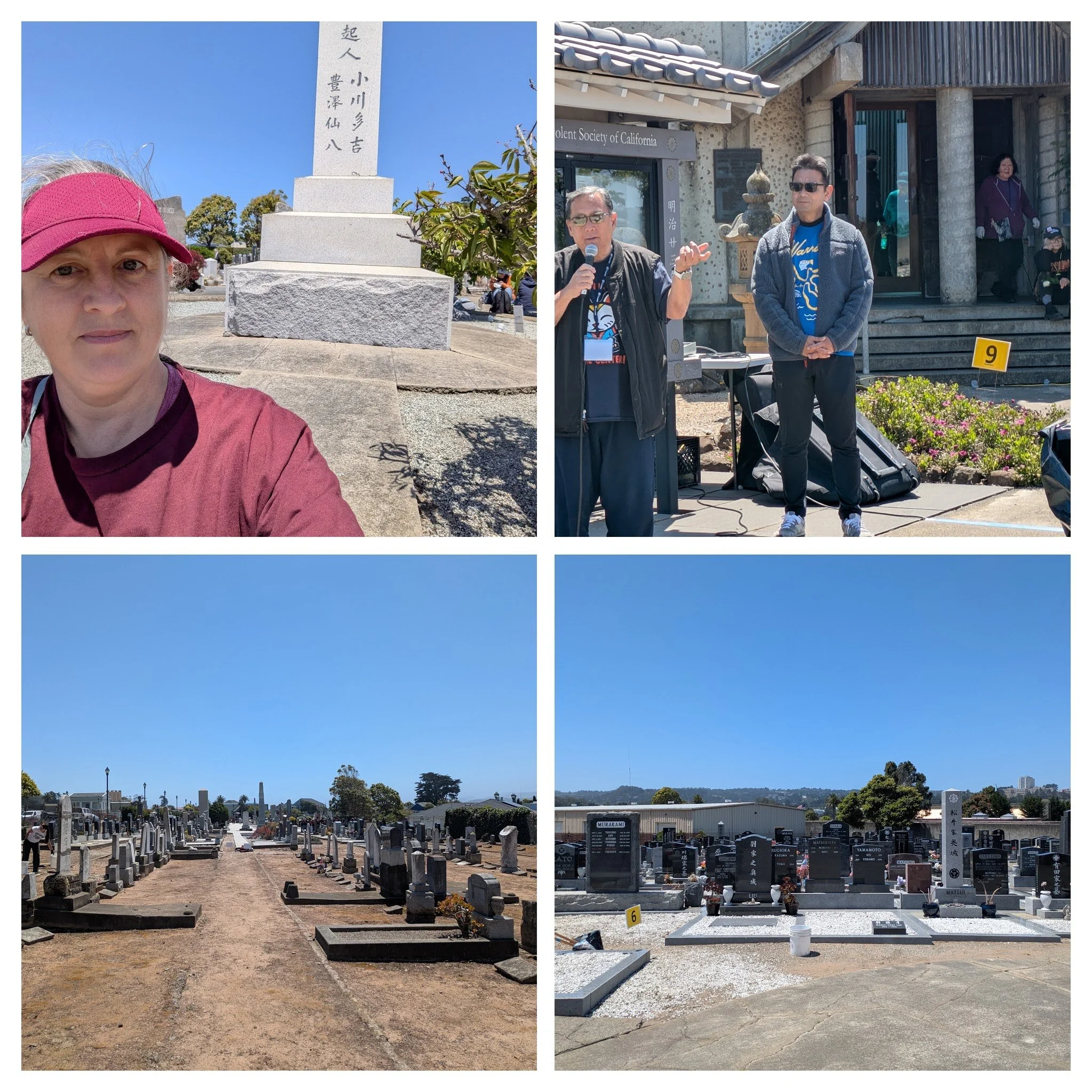
One of the stories that stayed with me as we worked was that of Paul Osaki, who began organizing these cleanups more than ten years ago. He noticed that the cemetery had become overgrown, especially in the older sections. Some of the graves belonged to his father’s friends, people who had once been visited and remembered, but whose resting places were no longer being tended. Even more striking were the graves of the first Japanese immigrants, some nearly hidden by waist high weeds, as if time and neglect were slowly erasing them.
Paul decided that was not acceptable. So he decided to involve the local Japanese-American community to help. Because of that commitment, this cemetery is no longer forgotten, and neither are the people resting there.
Knowing that history changed how the work felt. As my husband and I washed headstones, pulled weeds, and cleared paths, it did not feel like simple maintenance. It felt like joining a line of people who had decided that memory deserves attention. That respect is something you practice, not something you assume.
In Japan, caring for graves is an act of connection. Cleaning is not about fixing something broken. It is about presence. You show up because the relationship still exists, even if the person is gone. Standing in Colma, I felt that same sense of responsibility. Many of those buried there were the first to arrive, the first to work, the first to build community under circumstances that were often unwelcoming and unjust. They laid foundations without knowing who would come after them.
Preparing the cemetery so it would be beautiful for the Memorial Day service added another layer of meaning. Memorial Day asks us to remember sacrifice and service, and here, remembrance included lives of quiet endurance. Immigrants who crossed an ocean, built families, supported one another, and held on to dignity even when it was not returned to them.
What struck me again this year was the pace. No rushing. No shortcuts. Each grave was treated with care, whether someone still comes to visit or not. Especially those early graves, the ones Paul first noticed, the ones that remind us how easy it is for history to fade if no one tends it.
This being our second year mattered to me. There is something important about returning. About not treating this as a one time act of service, but as an ongoing relationship. That, too, is mindfulness. Showing up again. Remembering again. Choosing to care, even when it would be easier not to.
Because of people like Paul Osaki, and because of organizations like JCCCNC, this cemetery is not just a place of the past. It is an active space of remembrance. And now, in a small way, it is part of our own rhythm as well.
As we move into Memorial Day, I am carrying that with me. Respect is not abstract. It lives in actions repeated over time. Sometimes it looks like cleaning a stone. Sometimes it looks like returning the next year, and the year after that, to make sure those who came before are still seen.
We will be back next year.
